On the train from Munich to Pforzheim and from Pforzheim to Nuremburg I started thinking about what Souvenir I would create for this project. Here's what I was writing with a few additions:
Home is instinctual- whereever we've lived/stayed in Amsterdam and Munich I have been calling it home. In a way it is our home here; it's home base, where we can relax, hang out and sleep (without worrying about how cold it is outside) but it's not home with a captial 'H'.
I didn't really think about 'Home' until I skyped with my sisters as they were cooking dinner back in Sydney. We were having such a nice, long chat that they put the laptop they were talking to me through at the head of the dining table so that I could "have dinner with them" (we usually sit down to a family meal every night). There was laughter, lots of easy chatter, teasing and the occasional swear word - it made me really miss them.
Travelling with friends is hard, no matter how close (or not) you were to them at the start of the trip, friendships develop quickly. You find out your own and everyone's good and bad personality traits quickly and you have to learn to cope with whatever is happening. Sharing stories about eachother's 'Homes' was my favourite part about getting to know everyone. Everyone has such different family lives and upbringings; they all had relationships of varying degrees and strengths that was interesting to compare with my own.
"Gezellig", the dutch word from the beginning of the trip, has stuck with me throughout the trip. Every time I took another photo of another door I thought about who inhabited the spaces behind it.
Home means so many different things to different people and I think that's what I want to explore. I'm not sure if it fits with our brief yet but I think I'll have to look over that when I am less sleepy...
Showing posts with label Emma. Show all posts
Showing posts with label Emma. Show all posts
Thursday, March 14, 2013

Wednesday, March 13, 2013
Emma: The History of Jewellery in Pforzheim on Day 15

Pforzheim was beautiful! and it was snowing!! Not going to lie, I was pretty excited despite how cold it was.

The Jewellery Museum Pforzheim was our destination and it was well worth the walk. Seeing a museum based solely on jewellery was a little amazing. Not only did we get to see their One Hundred and One rings exhibition (spectacular!) but we also got to explore their contemporary and historical collections that were on display.

 |
| Jenny checking out the wall of tools. |
The contemporary collection part of a physical time line of the movements that Jewellery went through. I really liked being able to see an actual representation of the movements that were important to the development of our form of art. It's not something we get to learn about much in any of the general theory units at uni because we are usually looking at painting, sculpture and photography. We have done it in our object theory classes but this was much more specific because it was only jewellery [and not glass or ceramics].


I loved all of the ancient tribal jewellery because we got read about what jewellery was used for in various cultures and observe the parallels between those cultures and even ours. The collection was huge - donated by collectors who travelled the globe. There were pieces made for warriors, for decoration, for rank, for ceremonies, for religion. It was all intricate, handmade and so colourful!


 |
| Visitors stickers from the museum: an unintentional artwork on the traffic light |
Tuesday, March 12, 2013
Emma: Back to the Schmuck Fair on Day 14
We went back to the Schmuck Fair today to see a talk by the New Zealanders involved in the Handshake Project (check out their awesome blog here).
Sharon Fitness and Jessica Winchcombe talked about their experiences with their mentors and with the project so far. I was taking notes on what they were saying so I'll talk about some of the things that struck a chord with me.
Sharon Fitness talked first about her and her mentor Lisa Walker. Lisa, according to Sharon, is the "queen of found objects" and Sharon was saying how people would say that she was copying her because of her own interest in ready-made objects. Now, because of the mentee/mentor relationship that they have developed throughout the project, Sharon said that she can now tell aforementioned people exactly how she is not copying Lisa's work. This was a really important lesson for me because people obviously do arrive at similar points in their work but they can come from completely different making and conceptual decisions. I have worried before about how I'm meant to create something new or unique if "nothing is original" any more and this has shown me why I needn't be so worried about it.
Both Jessica and Sharon talked a lot about some of the benefits that they've experienced from the Handshake project and some things that we could take away from their experiences too. Both of them talked about how they and their mentors feed off eachother and use the experience and relationship as a chance to play and experiment. Jessica talked about how you didn't want to disappoint the artist and the audience who are always expecting bigger and better things as the project advances. She also talked about how, although they may not be in contact with their mentors all the time, they began to have pretend conversations with them because they know what they would say.
It was interesting hearing them both talk about the relationships they'd developed and the bouncing of ideas that happens when you're interacting with another person about art projects. I really like the idea of the project overall because it means that younger contemporary artists get a chance to interact with their artist idols and the artists themselves get to pass on skills and even learn some new ones themselves.
Sharon Fitness and Jessica Winchcombe talked about their experiences with their mentors and with the project so far. I was taking notes on what they were saying so I'll talk about some of the things that struck a chord with me.
Sharon Fitness talked first about her and her mentor Lisa Walker. Lisa, according to Sharon, is the "queen of found objects" and Sharon was saying how people would say that she was copying her because of her own interest in ready-made objects. Now, because of the mentee/mentor relationship that they have developed throughout the project, Sharon said that she can now tell aforementioned people exactly how she is not copying Lisa's work. This was a really important lesson for me because people obviously do arrive at similar points in their work but they can come from completely different making and conceptual decisions. I have worried before about how I'm meant to create something new or unique if "nothing is original" any more and this has shown me why I needn't be so worried about it.
Both Jessica and Sharon talked a lot about some of the benefits that they've experienced from the Handshake project and some things that we could take away from their experiences too. Both of them talked about how they and their mentors feed off eachother and use the experience and relationship as a chance to play and experiment. Jessica talked about how you didn't want to disappoint the artist and the audience who are always expecting bigger and better things as the project advances. She also talked about how, although they may not be in contact with their mentors all the time, they began to have pretend conversations with them because they know what they would say.
It was interesting hearing them both talk about the relationships they'd developed and the bouncing of ideas that happens when you're interacting with another person about art projects. I really like the idea of the project overall because it means that younger contemporary artists get a chance to interact with their artist idols and the artists themselves get to pass on skills and even learn some new ones themselves.
Emma: Suspended in Pink on Day 13
11th March. Monday.
We saw our last schmuck exhibition today called 'Suspended in Pink'. It was a good one to end on as it was one of the more striking exhibitions I've seen. Everything was pink!
We were all asking, why pink? We had it explained to us by a woman who i think was the curator Laura Bradshaw-Heap but I didn't write it down. Instead I'll write what is in the catalogue which is pretty much what she was saying anyway:
"There are numerous reasons, opening up a riot of explorations into pink's many connotations, cultural references and gender associations.
And yet, at the same time it is arbitrary. It is just a colour. Nothing more or less. It is a beginning."
I really like that despite the pieces having their own stories, their common thread was colour.
We saw our last schmuck exhibition today called 'Suspended in Pink'. It was a good one to end on as it was one of the more striking exhibitions I've seen. Everything was pink!
We were all asking, why pink? We had it explained to us by a woman who i think was the curator Laura Bradshaw-Heap but I didn't write it down. Instead I'll write what is in the catalogue which is pretty much what she was saying anyway:
"There are numerous reasons, opening up a riot of explorations into pink's many connotations, cultural references and gender associations.
And yet, at the same time it is arbitrary. It is just a colour. Nothing more or less. It is a beginning."
I really like that despite the pieces having their own stories, their common thread was colour.
Sunday, March 10, 2013
Emma: an adventurous day 12
10th March.
This morning we went to see Warwick Freeman do a talk at the Pinakothek der Moderne which was quite a lively interesting talk about how 'Kiwi' he is. I really enjoyed it for 3 different points he made right at the beginning and kind of referred to throughout his speech.
1. He quoted F Scott Fitzgerald who said the following in 1922:
"I want to make something new -- something extraordinary and beautiful and simple and intricately patterned"
I really liked it because Freeman paused for a moment and then said "and then he wrote The Great Gatsby soon after," almost as if by saying this he would create something grand after he read it and/or shared it (well thats my interpretation!)
2. The next thing Freeman quoted was a Maori proverb 'Kaore te kumara e whaakii ana tana reka' which translated roughly to: 'The kumara (sweet potatoe) does not say how sweet he is' (http://www.maori.cl/Proverbs.htm). He talked about how the title of his presentation was 'all about me' but that boasting was "not very Kiwi" and that Kiwi's almost have too much modesty. I think i really liked this because he was quite modest about his success and quite laid back about it compared to people who take their success for granted.
3. The other thing that I loved was Freeman's questioning of the term 'Kiwi'. He was basically talking about why New Zealanders would want to be named after small flightless birds that don't like to socialise. Instead, he said that he would rather be named after a Weka - and intelligent bird that is naturally inquisitive and likes shiny things. I liked this discussion at the beginning because he kept refering to himself as a weka or saying 'the weka in me' etc. and went on to explain his work in reference to being an inquistive bird and more generally, a 'Kiwi' (with a captial 'K'!).
I'm not sure if any of this will help me with my final work but it was something that I found really interesting and wanted to record here after i wrote really quick notes in the lecture.
So you may be wondering, why did i say we had an adventurous day? Well, the lecture brought me home because Warwick Freeman is a Kiwi and reminded me of Australia, so that was more of a personal adventure in my head. After we left the lecture we ventured to a total of 6 more galleries that took us right across the city.
We went to 3 really close to the Pinakothek. My favourite one of these that i'll quickly talk about was one by the Dialogue Collective. In the description it says "Thought provoking environments are fundamental to the group, and this exhibition is meant to bring people together through interactive events." and in 'Home and Away' [secret Australian reference there! 2nd time i thought of home :)] this was definitely tree. I think it was partially successful in how interactive it was: we had to decode a little quote to open the secret chest with a necklace inside and we got to write a prediction for ourselves and put it in a box for next year (we just kept and swapped ours so that we wouldn't be tempted to open them before next year!) It was probably the most interactive that i've been in an exhibition so i found it quite fun. Steph and i bought 'home' and 'away' necklaces - mine broke already :( but i'm a jeweller so i will fix it when i get home!


Our adventurous day then took us to 'Flora eats Fauna' at Schloss Nymphenburg which was in a castle! i was way to excited... but rightly so, it was beautiful! and so huge! It was understated but had intricate, gold decoration on the windows and the main centre building. It really was just spectacular - i wish we could come back in Spring, it's probably even more beautiful when the hedges aren't just branches...

We rushed across the city to get to the last 15 minutes of an exhibition that somehow involved coffee but it was sadly they had mostly packed up (serves us right for trying to get there for the last 10mins of a show...). There was, however, something really cool about getting trams from the east of the city to the west. We recognised cool doors, beautiful churches, squares, parks, statues, laneways, galleries, streets as we passed them by. We really have come to know this city! To me thats the amazing thing because despite being flooded with information and so many beautiful objects, we recognised lots of places that we passed by for a minute or two as we made our way from gallery to gallery.
This morning we went to see Warwick Freeman do a talk at the Pinakothek der Moderne which was quite a lively interesting talk about how 'Kiwi' he is. I really enjoyed it for 3 different points he made right at the beginning and kind of referred to throughout his speech.
1. He quoted F Scott Fitzgerald who said the following in 1922:
"I want to make something new -- something extraordinary and beautiful and simple and intricately patterned"
I really liked it because Freeman paused for a moment and then said "and then he wrote The Great Gatsby soon after," almost as if by saying this he would create something grand after he read it and/or shared it (well thats my interpretation!)
2. The next thing Freeman quoted was a Maori proverb 'Kaore te kumara e whaakii ana tana reka' which translated roughly to: 'The kumara (sweet potatoe) does not say how sweet he is' (http://www.maori.cl/Proverbs.htm). He talked about how the title of his presentation was 'all about me' but that boasting was "not very Kiwi" and that Kiwi's almost have too much modesty. I think i really liked this because he was quite modest about his success and quite laid back about it compared to people who take their success for granted.
3. The other thing that I loved was Freeman's questioning of the term 'Kiwi'. He was basically talking about why New Zealanders would want to be named after small flightless birds that don't like to socialise. Instead, he said that he would rather be named after a Weka - and intelligent bird that is naturally inquisitive and likes shiny things. I liked this discussion at the beginning because he kept refering to himself as a weka or saying 'the weka in me' etc. and went on to explain his work in reference to being an inquistive bird and more generally, a 'Kiwi' (with a captial 'K'!).
I'm not sure if any of this will help me with my final work but it was something that I found really interesting and wanted to record here after i wrote really quick notes in the lecture.
So you may be wondering, why did i say we had an adventurous day? Well, the lecture brought me home because Warwick Freeman is a Kiwi and reminded me of Australia, so that was more of a personal adventure in my head. After we left the lecture we ventured to a total of 6 more galleries that took us right across the city.
We went to 3 really close to the Pinakothek. My favourite one of these that i'll quickly talk about was one by the Dialogue Collective. In the description it says "Thought provoking environments are fundamental to the group, and this exhibition is meant to bring people together through interactive events." and in 'Home and Away' [secret Australian reference there! 2nd time i thought of home :)] this was definitely tree. I think it was partially successful in how interactive it was: we had to decode a little quote to open the secret chest with a necklace inside and we got to write a prediction for ourselves and put it in a box for next year (we just kept and swapped ours so that we wouldn't be tempted to open them before next year!) It was probably the most interactive that i've been in an exhibition so i found it quite fun. Steph and i bought 'home' and 'away' necklaces - mine broke already :( but i'm a jeweller so i will fix it when i get home!

The coded entry box!

our new necklaces!

In front of Schloss Nymphenburg (L-R: Peter, Steph, Me, Jenny, David. Chris was taking the photo!)

The gold trimmings

'Flora eats Fauna' exhibition space
We rushed across the city to get to the last 15 minutes of an exhibition that somehow involved coffee but it was sadly they had mostly packed up (serves us right for trying to get there for the last 10mins of a show...). There was, however, something really cool about getting trams from the east of the city to the west. We recognised cool doors, beautiful churches, squares, parks, statues, laneways, galleries, streets as we passed them by. We really have come to know this city! To me thats the amazing thing because despite being flooded with information and so many beautiful objects, we recognised lots of places that we passed by for a minute or two as we made our way from gallery to gallery.
Thursday, March 7, 2013
Emma: Gallery layouts on Day 9
7th March.
I thought yesterday was overwhelming! Eight galleries in one day is a lot! Especially because we traversed through a larger part of the city then we have seen in the past few days (It was still only 10 minutes to the furthest gallery on the train!)
Being able to see so many galleries in one day meant that I started to notice all of the different ways that exhibitions can be set up.
 Aftermath of Jewellery at the Museum Villa Stuck had (at a guess) 2m high walls that had shelves going all the way through the wall and out both sides. The work sat on these shelves with glass boxes over the top, which meant that you could see the pieces from different angles.
The next exhibition, Five Men, had lots of very architectural jewellery pieces that were really fascinating but my favourite part about this one was the concept and technical sketches on the walls. Each artist displayed his drawings near his work and I really liked being able to see the different drawing styles and methods of each artist. Some were really technical and accurate (1), some were just conceptual sketches in charcoal (2) and some were in between these (3). [note: I'm really sorry that I didn't write down who did which drawings but if I can figure it out I will update the post!] It was intriguing in that I could look at the drawings and the work and see how the pieces turned out in comparison to what the artists had planned.


At ConSpiracion, an exhibition of Spanish contemporary artists who are alumni of the Art and Design College of Valencia (EASD Valencia) and Barcelona (Escola Massana), I really liked the way the brooches on the walls were displayed. There were black and white photographs of different people but instead of the brooch being in the photo it was attached to the photo itself. I liked that you could get a sense of where the brooches sat in relation to the human body and its size, but you also got to experience the piece in its three dimensional form, not the 2D form you usually get when people combine photography with jewellery.

The last exhibition whose layout and design really interested me was Lunatic Swing with Australian artist Laura Deakin and 5 other artists who have graduated from the Academy in Munich. This exhibition captivated my attention because the walls split into two little pathways to explore; not only this, but the walls themselves bulged out in various heights and shapes along the wall, making me feel like I was in some kind of weird cave. At first I thought the walls were solid but after a quick touch I discovered that they were not! Fabric had been stretched over some kind of solid structure that the artists had built in the large space. All the work was sewn on at different heights so you really had to bend down or look up to see the details - I enjoyed the interactive nature of this.
In all, I'm starting to see how important exhibition design is. The ones I remembered the most from today were the ones with more interesting layouts with features that enabled you to interact or to be more involved with the pieces by being better able to observe them. It's something that I've been thinking about since Ruudt Peters talked to us about - exhibition layout was really important to him and helped him to add more layers to his pieces. In this same way, I think the exhibitions I've mentioned add different facets and illicit more curiosity because of the way that they have been set out.
I thought yesterday was overwhelming! Eight galleries in one day is a lot! Especially because we traversed through a larger part of the city then we have seen in the past few days (It was still only 10 minutes to the furthest gallery on the train!)
Being able to see so many galleries in one day meant that I started to notice all of the different ways that exhibitions can be set up.

The next exhibition, Five Men, had lots of very architectural jewellery pieces that were really fascinating but my favourite part about this one was the concept and technical sketches on the walls. Each artist displayed his drawings near his work and I really liked being able to see the different drawing styles and methods of each artist. Some were really technical and accurate (1), some were just conceptual sketches in charcoal (2) and some were in between these (3). [note: I'm really sorry that I didn't write down who did which drawings but if I can figure it out I will update the post!] It was intriguing in that I could look at the drawings and the work and see how the pieces turned out in comparison to what the artists had planned.

(1)

(2)

(3)

[I lost my memory card with the photos I took so for now I've borrowed this photo from SIERAAD Art Fair's Facebook page]
The last exhibition whose layout and design really interested me was Lunatic Swing with Australian artist Laura Deakin and 5 other artists who have graduated from the Academy in Munich. This exhibition captivated my attention because the walls split into two little pathways to explore; not only this, but the walls themselves bulged out in various heights and shapes along the wall, making me feel like I was in some kind of weird cave. At first I thought the walls were solid but after a quick touch I discovered that they were not! Fabric had been stretched over some kind of solid structure that the artists had built in the large space. All the work was sewn on at different heights so you really had to bend down or look up to see the details - I enjoyed the interactive nature of this.
In all, I'm starting to see how important exhibition design is. The ones I remembered the most from today were the ones with more interesting layouts with features that enabled you to interact or to be more involved with the pieces by being better able to observe them. It's something that I've been thinking about since Ruudt Peters talked to us about - exhibition layout was really important to him and helped him to add more layers to his pieces. In this same way, I think the exhibitions I've mentioned add different facets and illicit more curiosity because of the way that they have been set out.
Wednesday, March 6, 2013
Emma: Day 8 and our very first day of Schmuk!!
6th March
Our first day at Schmuk! We've been warned ever since we arrived in Europe that we would be bombarded and overwhelmed with information, artists and jewellery and now I understand why. There are so many people, and this was a relatively quiet day apparently.
Seeing the Schmuk and Talente awards was kind of cool after Karin showed us all the catalogues from previous years. There were some other interesting artists and galleries exhibiting but i think it was too much for my brain to process! None are really standing out apart from the ones i bought presents from, but i can say it was really interesting seeing so many contemporary jewellers together under one roof.
The most interesting part of the day was visiting Laura Deakin and Mari Ishikawa in their studio this afternoon. Both of their careers in Jewellery have been shorter than some of the other artists we've been meeting so it was nice to have a fresh take on the industry. They had a beautiful studio too! Each of them had their own room that was decorated in their own way with bits and pieces on shelves and on the walls. Both of their work was stunning - we were all in awe of Mari's work but i think the one I liked best was Laura's confused series. Confused earrings were earrings as a necklace or ring and Confused Necklaces were brooches. I thought it was a really simple but clever concept.
Note: we ended up seeing a woman on day 10 that was wearing a Confused Earring necklace which was very exciting!
Our first day at Schmuk! We've been warned ever since we arrived in Europe that we would be bombarded and overwhelmed with information, artists and jewellery and now I understand why. There are so many people, and this was a relatively quiet day apparently.
Seeing the Schmuk and Talente awards was kind of cool after Karin showed us all the catalogues from previous years. There were some other interesting artists and galleries exhibiting but i think it was too much for my brain to process! None are really standing out apart from the ones i bought presents from, but i can say it was really interesting seeing so many contemporary jewellers together under one roof.
The most interesting part of the day was visiting Laura Deakin and Mari Ishikawa in their studio this afternoon. Both of their careers in Jewellery have been shorter than some of the other artists we've been meeting so it was nice to have a fresh take on the industry. They had a beautiful studio too! Each of them had their own room that was decorated in their own way with bits and pieces on shelves and on the walls. Both of their work was stunning - we were all in awe of Mari's work but i think the one I liked best was Laura's confused series. Confused earrings were earrings as a necklace or ring and Confused Necklaces were brooches. I thought it was a really simple but clever concept.
Note: we ended up seeing a woman on day 10 that was wearing a Confused Earring necklace which was very exciting!
Monday, March 4, 2013
Emma: Good-bye Amsterdam, hello Munich!! Day 6
4th March [written on the plane, posted when I could go on the Internet in Munich]
Looking back over the city as we fly towards Munich I can see all the multi-coloured canal houses lined up in rows next to the canals and it makes me think that will miss Amsterdam - I already do a little bit and we've only just taken off.
This morning as we were walking to Amsterdam Centraal at 5am, there were a few people out and about. The majority were slightly seedy looking guys checking out the hookers and I thought "this is the underbelly of Amsterdam," as if it were hidden and i hadn't seen it before. Now, as we leave, I don't think this thought was entirely correct; I don't think Amsterdam tries to hide much of what I'd consider to be the underbelly of a city. Pretty much everything is exposed and embraced (as seen on some fantastically tacky tourist t-shirts).
It's not even just the fact that you know where hookers are because of a red light or that you know that a green light means you can get high legally that makes me think this. When we were exploring the city, especially when we were out in Apledoorn and more "suburban" towns, we noticed that residents don't hide anything either. In fact, there's a dutch word "gezellig" that means comfortable, homely etc., and the Dutch people like to show how "gezellig" their home is so they leave the curtains open. This means you can see inside their homes and see their decorations, their live spread out in front of you. They are open about everything and unashamed, which I love.

Looking back over the city as we fly towards Munich I can see all the multi-coloured canal houses lined up in rows next to the canals and it makes me think that will miss Amsterdam - I already do a little bit and we've only just taken off.
This morning as we were walking to Amsterdam Centraal at 5am, there were a few people out and about. The majority were slightly seedy looking guys checking out the hookers and I thought "this is the underbelly of Amsterdam," as if it were hidden and i hadn't seen it before. Now, as we leave, I don't think this thought was entirely correct; I don't think Amsterdam tries to hide much of what I'd consider to be the underbelly of a city. Pretty much everything is exposed and embraced (as seen on some fantastically tacky tourist t-shirts).
It's not even just the fact that you know where hookers are because of a red light or that you know that a green light means you can get high legally that makes me think this. When we were exploring the city, especially when we were out in Apledoorn and more "suburban" towns, we noticed that residents don't hide anything either. In fact, there's a dutch word "gezellig" that means comfortable, homely etc., and the Dutch people like to show how "gezellig" their home is so they leave the curtains open. This means you can see inside their homes and see their decorations, their live spread out in front of you. They are open about everything and unashamed, which I love.
Sunday, March 3, 2013
Emma: exploring amsterdam on day 5

3rd March.
Its our day off! Walking around the streets of Amsterdam is still lovely as ever so we explored. The canals that split streets in two; the bare trees lining the streets, fairy lights strung through some of them; the bikes piled everywhere - its picturesque! (well mostly, Amsterdam's red lights are scattered in lanes everywhere.
We went to Anne Frank's house in the morning which was heartbreaking and fascinating at the same time. Seeing the rooms her and her family had to hide in to escape persecution was so sad - especially because the rooms are empty at the request of Anne's father as he wanted the emptiness to serve as a reminder for what was lost. Seeing video and hearing certain people talk about her life after her family were discovered (from the tip off of a yet unknown person) made me almost cry. She has an incredible story.


Saturday, March 2, 2013
Emma: meeting some inspiring people on day 4
2nd March.
The two artists we met today had two very different approaches to developing work that I found intriguing to observe.
Ruudt Peters described a two year work cycle where he would 'eat' and digest research, images and inspiration in the first year and in the second year he would bring together this research into ideas and pieces of work.
I won't retell you all the projects he showed and talked us through but a pattern emerged in my eyes that showed how this 2 year cycle happens in the flesh. For all his projects he first showed us a plethora of images - be that related to alchemical symbols and thoughts, images related to the circle of life or DNA strands (just to name a few).
Next, he took us through how the inspiration combined together to form an idea for the work - for example: the ouroboros (a snake eating its own tail) lead to ideas about the life cycle which lead to a ring that you could wear both ways. One ring also had blackboard paint on it so that it would wear off, another layer of meaning in the piece (he has many different layers of meaning in all of his work).

Finally, the exhibition of the collection always had to add to the pieces and their meaning (another layer!). A lot of the exhibitions that Ruudt showed us had elements of performance by other people (men walking in wearing the pieces) or involved the audience to interact more with the exhibition. For the Ouroboros rings, Ruudt had the pieces installed on the roof beams and had the audience climb ladders to see them.
I really enjoyed seeing this process and the fact that it was of the same rhythm throught each new cycle. I also really liked being able to understand the multiple layer of meaning in each collection; you often don't get that depth when you go to see an exhibition because there's not a whole lot of information about the story behind the work.
One work I particularly connected with with was his 'Corpus' collection from 2011. Ruudt explained that Christianity was often too close to him to ever do a piece of work (hence exploring other religions for inspiration) but that in this case he wanted to give himself the freedom to try. He drew inspiration from Corpus Christi at Santa Spirito by Michelangelo which had the body of a 17 year old and the face of a 33 year old and made 3D corpus'. He then cut these off on the front to make a flattened surface (see image!) enabling the wearer to deal with the piece in an easier fashion - it looks abstract, so the person isn't wearing their religion on their sleeve, but the back shows Christ's face, which the wearer can choose to show someone.

Andrea Wagner on the other hand, seemed to move from one series to the next with mainly material exploration or inspiration spurred from entering into various competitions or exhibitions whilst still having a longer cycle with series' of work. The thing I found most interesting about her talk was the variety of materials that she has used from collection to collection. She's cast found objects, rubber cast porcelain, made her own felt - just to name a few. There seems to be a line drawn through her work in the same way that various religious and other symbols were the thread throughout Ruudt's work. With Andrea however, this thread seems to be more about relationships, human thought and nature. There were two series of her work that intrigued me the most: 'Wonderbliss' (2000-2002) and 'The Architect Who Faced His Jardin Interieur' (2006). 'Wonderbliss' interested me because of her interesting combination of hand dyed felt with sterling silver and gold pieces. The other interesting thing about this series is that despite the fact that they look like imaginative creatures or plants from Alice's wonderland, Andrea describes them to be representative of human interactions and human insecurity. She wanted them to be sexually tinted and about the vulnerability of relationships. The quote off her website describes it in a particularly nice way (which i guess is the point of these things on a website!) "The implicit eroticism is somewhat in contrast to the "homeyness" in the work creates a provoking duality."

The two artists we met today had two very different approaches to developing work that I found intriguing to observe.
Ruudt Peters described a two year work cycle where he would 'eat' and digest research, images and inspiration in the first year and in the second year he would bring together this research into ideas and pieces of work.
I won't retell you all the projects he showed and talked us through but a pattern emerged in my eyes that showed how this 2 year cycle happens in the flesh. For all his projects he first showed us a plethora of images - be that related to alchemical symbols and thoughts, images related to the circle of life or DNA strands (just to name a few).
Next, he took us through how the inspiration combined together to form an idea for the work - for example: the ouroboros (a snake eating its own tail) lead to ideas about the life cycle which lead to a ring that you could wear both ways. One ring also had blackboard paint on it so that it would wear off, another layer of meaning in the piece (he has many different layers of meaning in all of his work).
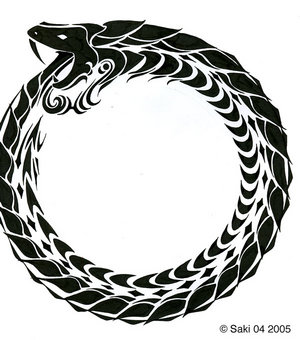
Ouroboros
Finally, the exhibition of the collection always had to add to the pieces and their meaning (another layer!). A lot of the exhibitions that Ruudt showed us had elements of performance by other people (men walking in wearing the pieces) or involved the audience to interact more with the exhibition. For the Ouroboros rings, Ruudt had the pieces installed on the roof beams and had the audience climb ladders to see them.
I really enjoyed seeing this process and the fact that it was of the same rhythm throught each new cycle. I also really liked being able to understand the multiple layer of meaning in each collection; you often don't get that depth when you go to see an exhibition because there's not a whole lot of information about the story behind the work.
One work I particularly connected with with was his 'Corpus' collection from 2011. Ruudt explained that Christianity was often too close to him to ever do a piece of work (hence exploring other religions for inspiration) but that in this case he wanted to give himself the freedom to try. He drew inspiration from Corpus Christi at Santa Spirito by Michelangelo which had the body of a 17 year old and the face of a 33 year old and made 3D corpus'. He then cut these off on the front to make a flattened surface (see image!) enabling the wearer to deal with the piece in an easier fashion - it looks abstract, so the person isn't wearing their religion on their sleeve, but the back shows Christ's face, which the wearer can choose to show someone.

Corpus Scapula, 2011

Voloptas Propulsa 2000-2002
Concerning "The Architect Who Faced His Jardin Interieur", I think visually these pieces really appealed to me because they look like a secret garden that is a little over grown in places. They have colour and structure and are just really beautiful. I like the idea that they represent the imagination where we are allowed to fantasise and use our imagination to our hearts content. (I'll add some photos soon!)
Friday, March 1, 2013
Emma: Observations from day 3
1st March.
The Stedelijk museum was the first place we ventured to today. It's the modern and contemporary art museum in Amsterdam and had an incredibly large, broad range of art spread across the older and newer wings. The most time I spent here was in the design section of the museum where there was furniture, jewellery, posters, ceramics, glass work etc from 1900 onwards. There were some really interesting pieces that used materials in a different way to what I've seen. There was a lacquered copper vase, patinated copper, an interesting woven piece by Ria Van Eyk made from PVC and polythene.

There was also an exhibition on Mike Kelley's life work - he was insane but there was some amazing art. The artwork below was one of my favourites - he start with an image of (i think) trees and tree roots) and expanded it outwards.

The work in Terhi Tolvanen's 'Curiousity Collection' at Rob Koudijs' gallery was probably my favourite so far. I found Tolvanen's use of materials really fascinating because of the way she made pieces of jewellery look like they came fr the bottom of the ocean - which fits with what i think is a reference to the Curiousity Cabinets that were popular and usually filled with shells, flora and other naturally found souvenirs.
To make rust she ground up a composite of stones, sand and other materials and mixed this with a glue (not quite sure what Rob told us, maybe a polyurethane or something) and applied it to the structure. A coral necklace (I'll find the name of the piece and get back to you) was a wooden structure that had strings of small pink pearls attached to the edge. Tolvanen then filled in the surrounds with concrete. You would expect this necklace to be quite heavy but because the middle is hollow, the piece was actually quite light weight. A client came into the gallery and tried it on too, it looked beautiful on the body! A lot of the work had some really interesting findings (hinges, catches etc) and it all fit together as a collection of work.

The Stedelijk museum was the first place we ventured to today. It's the modern and contemporary art museum in Amsterdam and had an incredibly large, broad range of art spread across the older and newer wings. The most time I spent here was in the design section of the museum where there was furniture, jewellery, posters, ceramics, glass work etc from 1900 onwards. There were some really interesting pieces that used materials in a different way to what I've seen. There was a lacquered copper vase, patinated copper, an interesting woven piece by Ria Van Eyk made from PVC and polythene.

Infinite Expansion 1983
acrylic on paper, super imposed
6 parts
The Broad Art Foundation, Santa Monica
To make rust she ground up a composite of stones, sand and other materials and mixed this with a glue (not quite sure what Rob told us, maybe a polyurethane or something) and applied it to the structure. A coral necklace (I'll find the name of the piece and get back to you) was a wooden structure that had strings of small pink pearls attached to the edge. Tolvanen then filled in the surrounds with concrete. You would expect this necklace to be quite heavy but because the middle is hollow, the piece was actually quite light weight. A client came into the gallery and tried it on too, it looked beautiful on the body! A lot of the work had some really interesting findings (hinges, catches etc) and it all fit together as a collection of work.

Antoinette 2013
Pearls, cement, wood, silver
Thursday, February 28, 2013
Emma: Seeing some classics on day 2
28th February:
Despite not having the widest view of the contemporary jewellery world, it is amazing to meet artists who I've heard of or read briefly about in books. They've all been so lovely to us; telling us their stories and sharing their work and ideas. It's inspiring to see the way different people work, think and create in their different spaces.
Ela Bauer was the first artist we visited. She had a very cute little studio right on the banks of a canal. The room was filled with evidence of her work. Her walls were white but had work, photos, inspirations and samples pinned to them (which I loved! See the photo). Myself and some of the others were talking about how this is important because somehow you always seem to draw inspiration from old work. It's like the stepping stone to the next material or idea. The other thing I liked about Ela's talk was seeing and hearing about her exploration of materials polyurethane and silicone in particular. She talked about how we should talk with the things we are making: not only imposing your ideas but working with the material and using that to take you places as well.
We went to Gallerie Ra and had a really interesting talk with the owner (who is also and artist with some amazing work!). It was a kind of 'behind-the-scenes' look at the way a gallery and it's artists interact.
The part of the talk that interested me the most was about the directions contemporary jewellery could've gone in in comparison to where it has gone. Of the three options: art, industrial/product design and fashion, Paul said that it ha gone in the art direction whilst it forgot that the other options were there too. He also said that we forget about young people sometimes and that we need to enlarge the size of our market.
"when it's out of fashion, we call it classic"
(Paul Derrez)

Despite not having the widest view of the contemporary jewellery world, it is amazing to meet artists who I've heard of or read briefly about in books. They've all been so lovely to us; telling us their stories and sharing their work and ideas. It's inspiring to see the way different people work, think and create in their different spaces.
Ela Bauer was the first artist we visited. She had a very cute little studio right on the banks of a canal. The room was filled with evidence of her work. Her walls were white but had work, photos, inspirations and samples pinned to them (which I loved! See the photo). Myself and some of the others were talking about how this is important because somehow you always seem to draw inspiration from old work. It's like the stepping stone to the next material or idea. The other thing I liked about Ela's talk was seeing and hearing about her exploration of materials polyurethane and silicone in particular. She talked about how we should talk with the things we are making: not only imposing your ideas but working with the material and using that to take you places as well.
We went to Gallerie Ra and had a really interesting talk with the owner (who is also and artist with some amazing work!). It was a kind of 'behind-the-scenes' look at the way a gallery and it's artists interact.
The part of the talk that interested me the most was about the directions contemporary jewellery could've gone in in comparison to where it has gone. Of the three options: art, industrial/product design and fashion, Paul said that it ha gone in the art direction whilst it forgot that the other options were there too. He also said that we forget about young people sometimes and that we need to enlarge the size of our market.
"when it's out of fashion, we call it classic"
(Paul Derrez)
Wednesday, February 27, 2013
Emma: Day 1 and Overwhelmed Already
After almost 24 hours on planes we finally arrived in Amsterdam! It's my first time in Europe so I'm excited about everything: the buildings, the people, the culture - its fascinating. We ventured to CODA in Apledoorn and Marzee in Nijmegen - two amazing galleries in two gorgeous towns.
There are cobblestones everywhere! We kept noticing that when they need to do repairs or fix something, they just dismantle the pavement and then put it back together after. I really liked the idea that something can be so easily fixed and moved
I also really love the character that the cobblestones give Amsterdam itself and in Apledoorn/Nijmegan. I like that you couldn't really tell where the footpaths ended and bike lanes started (especially in the towns) apart from a subtle change in the pattern or level of the cobblestones. The other thing about Amsterdam that I find absolutely charming are all of the finishings on the houses. Every window and door frame is white (mostly), the balaconies and moulding are decorated, there are coloured tiles and bricks worked into the walls; they are mostly old buildings but have elements thay have been renovated and changed. It's also been interesting to see
The galleries themselves had their own character but i found Marzee particularly striking. I really liked the industrial, raw look of the gallery: The old pipes, concrete floors, galvanized steel stairs, exposed brick walls. When we were going upstairs someone said "shhh" because we wereaking noise on the metal stairs but my thought was that if they wanted us to be quiet they wouldn't have made metal stairs. I think it enabled us to talk more freely about the work in the gallery and to really explore every part of it.
There is so much to see in the cities and in the galleries, so many artists and an entirely different culture. It's a lot to take in, but I am loving it!

There are cobblestones everywhere! We kept noticing that when they need to do repairs or fix something, they just dismantle the pavement and then put it back together after. I really liked the idea that something can be so easily fixed and moved
I also really love the character that the cobblestones give Amsterdam itself and in Apledoorn/Nijmegan. I like that you couldn't really tell where the footpaths ended and bike lanes started (especially in the towns) apart from a subtle change in the pattern or level of the cobblestones. The other thing about Amsterdam that I find absolutely charming are all of the finishings on the houses. Every window and door frame is white (mostly), the balaconies and moulding are decorated, there are coloured tiles and bricks worked into the walls; they are mostly old buildings but have elements thay have been renovated and changed. It's also been interesting to see
The galleries themselves had their own character but i found Marzee particularly striking. I really liked the industrial, raw look of the gallery: The old pipes, concrete floors, galvanized steel stairs, exposed brick walls. When we were going upstairs someone said "shhh" because we wereaking noise on the metal stairs but my thought was that if they wanted us to be quiet they wouldn't have made metal stairs. I think it enabled us to talk more freely about the work in the gallery and to really explore every part of it.
There is so much to see in the cities and in the galleries, so many artists and an entirely different culture. It's a lot to take in, but I am loving it!
Subscribe to:
Posts (Atom)